Somewhere between “is this legal?” and “is this actually good quality?” sits a whole layer of paperwork most buyers never think to check. Farm Bill hemp compliance is the thing quietly determining whether a product is allowed to exist on the market at all, and it matters a lot more than package design or a flashy strain name.
A quick note before diving in: this is general information, not legal advice. Hemp laws shift by state, so it’s worth double-checking your own local regulations before ordering anything.
What Is Farm Bill Hemp Compliance, Really?
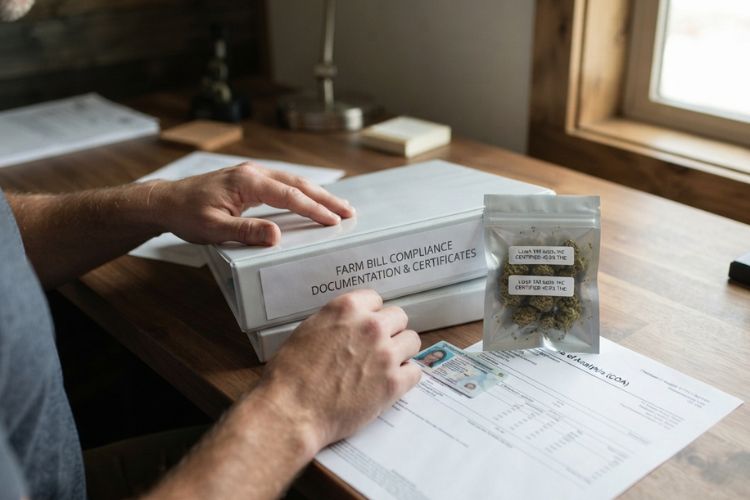
Simply put, farm bill hemp compliance is about whether some product can legally be declared hemp, or instead falls into the category of marijuana. What matters is just one number – Delta-9 THC content as measured on a dry weight basis. If the level of Delta-9 THC exceeds a certain limit, the product will be deemed to belong to another legal category regardless of what the label says.
This single number is the backbone of the entire legal hemp industry in the United States, which is exactly why it shows up on every legitimate lab report.
The 2018 Farm Bill Hemp Compliance Baseline
Everything traces back to one piece of legislation. The 2018 Farm Bill hemp compliance standard removed hemp, defined as cannabis containing no more than 0.3% Delta-9 THC by dry weight, from the federal Controlled Substances Act. That single change is the reason hemp-derived products can legally be sold and shipped across most of the country today.
It’s worth noting this law set a federal floor, not a universal green light. States retained the ability to add their own restrictions on top of it, which is part of why legality can look different depending on where an order is headed.
Is Hemp-Derived THCA Legal?
This is probably the most common question buyers actually have, and the answer is a careful “generally, yes, with conditions.” Is hemp-derived THCA legal federally? In its raw, unconverted form, yes, as long as the product tests under that 0.3% Delta-9 THC threshold. The complication is that THCA converts to Delta-9 THC when heated, which has led some states to interpret total potential THC differently than the federal government does.
In practice, this means a product can be fully compliant on paper federally while still facing restrictions in specific states that measure things differently.
Can Hemp Products Be Shipped to Any State?
No, not always. While most states allow hemp items that comply with the federal regulations to be shipped, there are a few places that impose additional restrictions, such as total bans on certain cannabinoids or stricter limits on the potency. Sellers that can be trusted will most likely acknowledge their limitations concerning the states to which they can ship their items.
What Makes Farm Bill Compliant Hemp Products
A handful of specific markers separate genuinely compliant products from ones just claiming to be:
- Lab-verified Delta-9 THC under 0.3% on a dry weight basis, confirmed by an accredited third-party lab.
- A current certificate of analysis tied to the actual batch being sold, not an outdated report reused across a whole product line.
- Clear sourcing information, showing the hemp was grown and processed within federal guidelines.
- Transparent labeling, without vague or misleading claims about potency or legality.
Every one of those markers should be easy to find on a product page. If a seller is vague about any of them, that alone is worth pausing on. Checking the actual certificate of analysis before you buy is the single fastest way to confirm farm bill compliant hemp products are actually what they claim to be, rather than just trusting label language.
Buying Hemp Online Legally: What to Check Before You Order
A few habits make buying hemp online legally a lot less risky:
- Check the seller’s shipping restrictions before assuming a product can reach your state.
- Look for a published COA on every product page, not just a general “lab tested” claim.
- Confirm the Delta-9 THC percentage is clearly listed and under the federal threshold.
- Avoid sellers who dodge questions about compliance or can’t produce documentation on request.
None of this takes more than a few minutes per order, but skipping it is exactly how buyers end up with products that turn out to be non-compliant in their state, or worse, mislabeled entirely.
Red Flags That Signal Non-Compliant Products
A few indicators must be taken seriously, including the unavailability of a COA on the website, suspiciously high cannabis content, vague sourcing phrases, or sellers who do not respond to questions about shipping limits. However, while everything mentioned here does not imply that the product is illegal, they indicate the seller does not take compliance matters seriously.
In case you intend to buy THCA flower online, effective proof of compliance should be regarded as a standard requirement, not a rare benefit provided by some sellers.
Final Word: Farm Bill Hemp Compliance in Practice
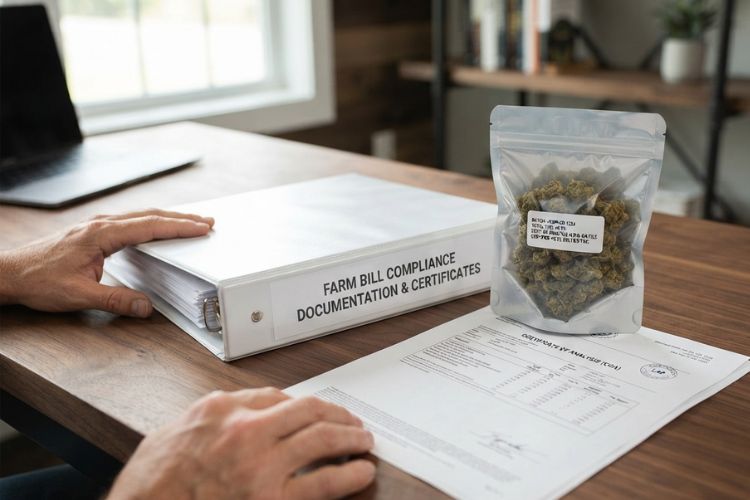
To sum it all up, Farm Bill hemp compliance is not something one can just find in the fine print. It makes all the difference between a legitimate product and an item that relies on a loophole. Thus, one should be aware of Farm Bill hemp compliance standards, know that the legal status of THCA obtained from hemp can change depending on a state, and check for proof of compliance before making a purchase.
Kingstone Pharms ships Farm Bill hemp compliance-verified, lab-tested products with a current COA published for every batch, so you’re never left guessing whether what’s in your cart is actually allowed to be there.
FAQs
Does farm bill compliance mean a product is legal in every state?
Not automatically. Federal compliance sets a baseline, but individual states can add their own restrictions on top of it, so it’s worth checking local laws too.
How is Delta-9 THC percentage measured for compliance?
It’s measured on a dry weight basis by an accredited lab, and that number is what determines whether a product legally qualifies as hemp under federal law.
What happens if a product exceeds the legal THC limit?
It no longer qualifies as legal hemp under federal law and would instead fall under marijuana regulations, which vary significantly by state.
Can I request a seller’s compliance documentation before buying?
Yes, and you should. Any legitimate seller should be able to provide a current COA and clear compliance information without hesitation.